
Crypto Scams: Fake Support, Fake Apps and Fake Airdrops
Crypto-related losses reported to the FBI hit $11.4 billion in 2025. Here is how fake support, fake apps, fake airdrops and investment and recovery scams work, and how to spot each.

Written by Hannah Lee
7 min read
The crypto scams to know are investment fraud, fake support agents, fake recovery services, fake wallet apps and fake airdrops. They look different, but each ends the same way: you hand over your recovery phrase, send crypto yourself or sign a request you have not read. No legitimate company needs any of those.
Below are the figures from the FBI's latest annual report, published in April 2026, followed by how each scam starts, its red flags and the rule that beats it. The patterns are old, but 2025 added new twists, from fake wallet extensions to fake law firms.
- People reported $11.366 billion in crypto-related losses to the FBI's Internet Crime Complaint Center in 2025, up 22 percent from 2024. Investment fraud alone accounted for about $7.2 billion.
- No real support agent, app or airdrop needs your recovery phrase. Anyone who asks for it is trying to steal from you.
- Start every support contact yourself, through the official website.
- Install wallets only from links on the project's official site, because fake apps and extensions copy names, logos and reviews.
- A platform that wants a fee before you can withdraw, or a "recovery" firm that wants one upfront, is the scam.
The FBI's Internet Crime Complaint Center (IC3) received 181,565 complaints involving cryptocurrency in 2025, and its 2025 annual report breaks them down by crime type. People aged 60 and over reported $4.43 billion of the losses. The figures come from victims' own reports and some cases fit several categories, so treat them as a guide rather than an exact count.
| Scam type | How it usually starts | Complaints (2025) | Reported losses |
|---|---|---|---|
| Investment fraud | A text, social media contact, ad or dating match who introduces a trading platform | 61,559 | About $7.2 billion |
| Recovery scams | A "recovery service" or "law firm" contacts someone who already lost money | 10,516 | $1.4 billion* |
| Tech and customer support | A pop-up, a search result or a reply from "support" | 17,355 | $1.23 billion |
| Romance | An online relationship that turns to investing or emergencies | 5,925 | $395 million |
| Government impersonation | A caller who claims your accounts are under investigation | 5,955 | $281 million |
| Phishing and spoofing | Fake websites, emails and messages | 7,164 | $111 million |
*The FBI notes that recovery scam losses may include money lost in the earlier scam that led the victim to the "recovery" company. Categories overlap in other ways too, since many investment scams begin on dating apps.
Crypto ATMs deserve a mention of their own. They are a payment method rather than a scam, but scammers steer victims to them: the IC3 logged 13,460 crypto ATM and kiosk complaints with $389 million in losses in 2025, and $257 million of that came from people aged 60 and over.
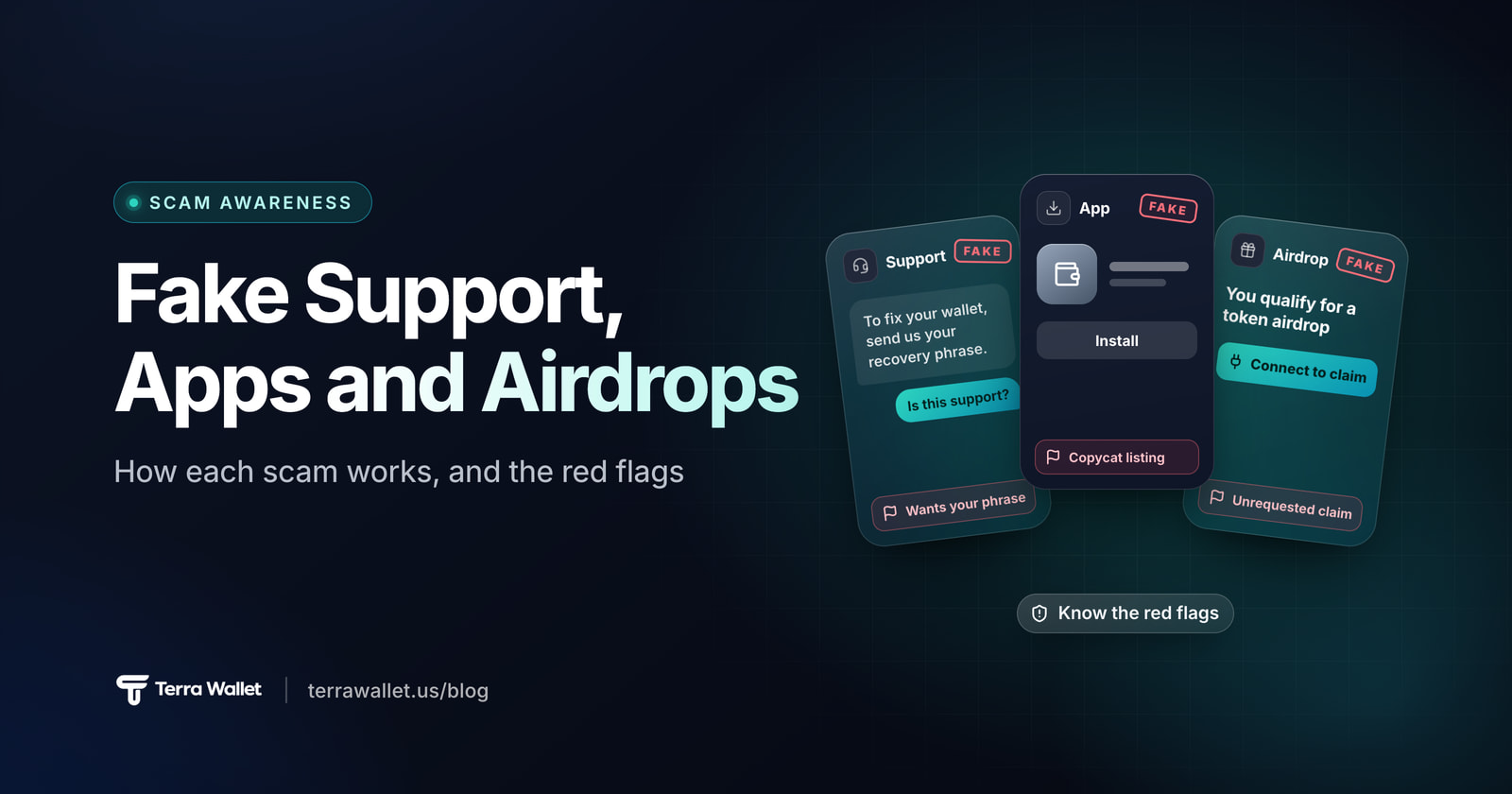
Fake support goes straight for your wallet. It often starts after you post about a problem in public, when "support" replies or sends a direct message with a convincing name and logo. What follows is always a version of the same request:
- "Validate", "sync" or "restore" your wallet on a website that asks for your recovery phrase.
- Share your screen or install a remote-access app so they can "see the error".
- Move your funds to a "safe" wallet while they fix your account.
- Pay a fee to release a "stuck" transaction or a frozen balance.
The rule that beats it: no legitimate support team needs your recovery phrase or private key, and real help starts when you contact support, not when "support" contacts you. Go through the official website, typed in by hand. For Terra Wallet, that is the official support page, where you sign in with a one-time code sent to your email. The support team of a non-custodial wallet also cannot reset your passcode or move your funds, so anyone offering to do so is lying.
A fake wallet looks right until the day it empties you. It copies a real wallet's name and logo, buys fake reviews and sometimes clones the real app's code with a few lines added. Two recent cases show how convincing they get:
- Google Play, 2024. Check Point Research found an app posing as WalletConnect, the protocol that links wallets to dApps. Listed in March 2024, it used fake reviews to climb search results, passed 10,000 downloads and stayed up for nearly five months, taking about $70,000 from more than 150 users before it was removed.
- Firefox add-ons, 2025. In July 2025, Koi Security reported more than 40 fake wallet extensions in Mozilla's store, active since at least April. They copied the names and logos of well-known wallets, showed far more five-star reviews than real installs and sent users' recovery phrases and keys to the attackers.
To install safely, run four checks:
- Open the store listing from the project's official website, not from a search ad or a message.
- Check the developer name and the app or extension ID against what the official site lists.
- Be suspicious of any app for a platform the project does not support. Terra Wallet has no iPhone app at the moment, for example, so an iPhone app using its name is not real.
- Remember that a real wallet asks for your recovery phrase only when you choose to import or restore a wallet.
Terra Wallet's official links are all on the download page, including Google Play, the direct APK and the Chrome Web Store listing for the browser extension. Bookmark that page rather than searching the stores each time.
Anyone can send tokens or NFTs to any address, and scammers use that to put bait straight into your wallet. The token's name or description carries a website and promises a reward if you claim it. The claim site then asks for your recovery phrase or a signature that hands over your tokens. Our guide to spotting spam NFTs shows what this bait looks like in a wallet.
In June 2025, the FBI warned about exactly this pattern on the Hedera network: unsolicited NFT "rewards" with a link in the transaction memo, leading to a site that connected the victim's wallet to a dApp and asked for the seed phrase. Related tricks include "eligibility checker" sites that ask you to connect and sign before showing a fake allocation, and giveaway posts that promise to double any crypto you send. No real giveaway asks you to send funds first.
The rule that beats it: treat anything you did not ask for as bait. Do not open links in token names or memos, do not try to sell an unknown token on an unfamiliar site, and claim real airdrops only through the project's official website. Receiving a spam token does not compromise your wallet, but interacting with it can, and our crypto phishing checklist shows how to check a claim site before you connect.
Investment fraud is the most expensive crypto scam by far. The FBI describes long cons run largely by organized criminal groups based in Southeast Asia, often using victims of human trafficking as forced labor. The scammer makes contact by text, social media, an ad or a dating app, moves the chat to a messaging platform and introduces a trading platform that shows impressive fake profits.
When the victim tries to withdraw, they are charged "taxes" and "fees", and then the scammers disappear. This pattern is widely known as pig butchering.
Recovery scams then target the same people a second time. In an August 2025 public service announcement, the FBI described fake law firms that claim to work with government agencies, cite made-up regulators, already know the dates and amounts of a victim's past transfers and demand fees in crypto or gift cards. The FBI's own red flags are blunt: no law firms are officially authorized partners of US government agencies, and the US government does not request payment for law enforcement services.
- If a platform says you must pay a fee or tax before you can withdraw, the money is already gone. Do not send more.
- If someone offers to recover lost crypto for an upfront fee, it is a scam.
- Report losses directly to the IC3 or your local police, with transaction hashes and addresses, and be wary of anyone who later contacts you claiming to be from those agencies.
Yes, every time. Support for a non-custodial wallet never needs your recovery phrase or private key, and anyone who has the phrase controls your funds. If you already shared it, create a new wallet right away and move everything to it.
Usually not, because blockchain transactions are final. Report the loss to the IC3 or your local police with the transaction hashes, and contact any exchange the funds went to. Be very wary of anyone who offers recovery for a fee.
They are almost always airdrop spam meant to lure you to a phishing site. A spam token cannot move your funds by itself, so ignore it and do not visit links in its name. The wallet FAQ on spam tokens explains how they are filtered, and our guide to address poisoning covers the related trick of tiny fake transfers.
Sources
- ic3.gov: 2025 IC3 Report PDF (opens in a new tab)
- ic3.gov: PSA250813 (opens in a new tab)
- ic3.gov: PSA250603 (opens in a new tab)
- research.checkpoint.com: WalletConnect scam a case study in crypto drainer… (opens in a new tab)
- thehackernews.com: Over 40 malicious Firefox extensions (opens in a new tab)
- theblock.co: FBI says crypto related fraud losses hit record… (opens in a new tab)