
Non-Custodial Wallet: What It Is and Why It Matters
A non-custodial wallet puts the keys, and the responsibility, in your hands. Here is how self-custody works, what it protects you from and what it asks of you.

Written by Sarah Mitchell
7 min read
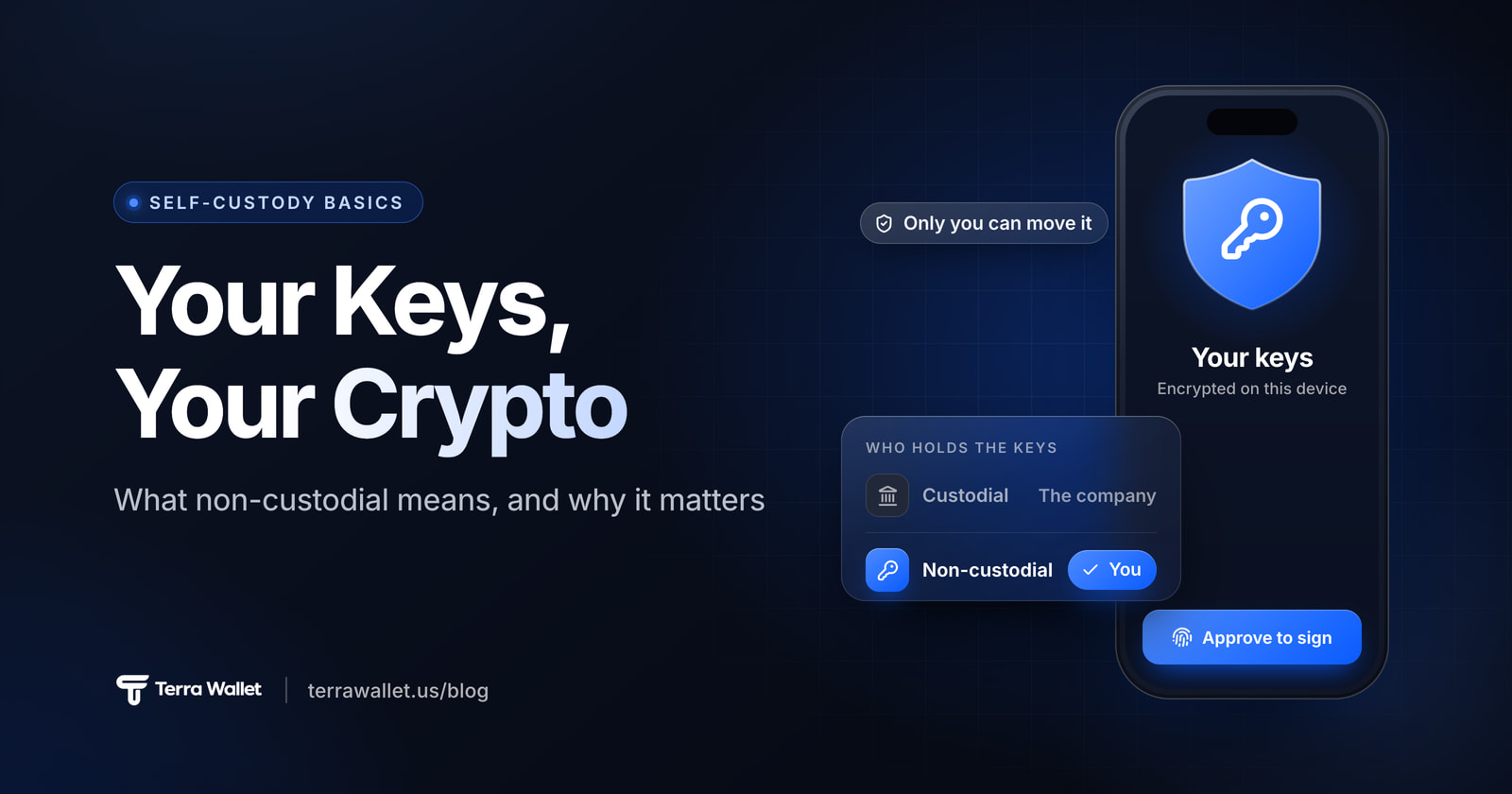
A non-custodial wallet is a crypto wallet where you hold the private keys, so only you can move your funds. No company keeps a copy of your keys, no platform can pause your withdrawals, and no one can reset your password for you. Your coins stay on the blockchain, at addresses only your keys control.
- With a non-custodial wallet you hold the keys, so the company that makes the app cannot move, freeze or recover your funds.
- Your 12 or 24-word recovery phrase is the real backup. Lose it and the device, and nobody can restore the wallet.
- Custodial platforms can stop withdrawals, as Celsius did in June 2022 and FTX in November 2022, and FDIC insurance does not cover crypto platforms that fail.
- Self-custody moves the risk to you: phishing, harmful signatures and lost backups are the main threats.
- Since Ethereum's Pectra upgrade on May 7, 2025, a regular address can also delegate to smart contract code, so read every authorization request.
A wallet does not hold coins. Your balance is a record on a public blockchain, attached to an address. What the wallet holds is the private key for that address, a secret number that signs the transactions that move your funds. The network checks the signature, not your name, so whoever has the key controls the money.
Most wallets create their keys from a recovery phrase of 12 or 24 words, also called a seed phrase. The common standard, BIP39, turns random data into words from a fixed list of 2,048. A 12-word phrase carries 128 bits of randomness and a 24-word phrase carries 256 bits, far beyond anything a computer could guess.
So a non-custodial wallet has three parts:
- The recovery phrase, the master backup you write down and keep offline. It can rebuild every key on any device.
- The private keys, calculated from the phrase and stored encrypted on your phone, computer or hardware device.
- The app, which shows balances, builds transactions and asks for your approval before it signs anything.
A custodial wallet is any service where a company holds the keys for you: an exchange account, a broker app that sells crypto, a lending or yield platform. You sign in with a password, and the company moves coins on your behalf.
| Question | Custodial (exchange or app account) | Non-custodial wallet |
|---|---|---|
| Who holds the private keys | The company | You |
| Getting started | Account, email and usually ID checks | No account needed to hold crypto |
| Forgot your password | The company can reset it | Restore the wallet with your recovery phrase |
| Lost the recovery phrase and the device | Not applicable | The funds cannot be recovered |
| Withdrawals | Can be paused, limited or refused | Whenever the network is running |
| If the company fails | You file a claim in a bankruptcy process | Your funds are not affected |
| Where the main risk sits | With the company: insolvency, hacks, freezes | With you: lost backups, scams, careless signing |
Neither column is risk-free. Custody hands the risk to a company you have to trust, and self-custody hands it to you. The real question is which of those risks you would rather manage.
- Custodial makes sense for money you are actively trading, for converting crypto to and from your bank account, and for a first purchase while you learn.
- Non-custodial makes sense for anything you plan to hold, for using dApps, swaps and staking from your own address, and for any amount you could not afford to see frozen.
- A hardware wallet makes sense once an amount would really hurt to lose. It is still non-custodial, with the keys kept offline.
The case for a non-custodial wallet is not abstract. Crypto on an exchange or a lending app is a claim against a company that holds the keys, and several of the largest losses in crypto came from such companies, not from flaws in Bitcoin or Ethereum. When they failed, that claim decided whether customers got their money back.
- Mt. Gox. The exchange collapsed in 2014. Its trustee only began repaying former customers in bitcoin and bitcoin cash in July 2024, more than ten years later.
- Celsius. The lender paused all withdrawals, swaps and transfers on June 12, 2022 and filed for bankruptcy on July 13. In January 2023 the court ruled that coins in its Earn accounts belonged to the company's estate under its terms of use (read the opinion), which left those customers with unsecured claims.
- FTX. The exchange stopped processing withdrawals in early November 2022 and filed for bankruptcy on November 11. The SEC alleged that customer money had been diverted to an affiliated trading firm. The first repayments, to customers with smaller claims, began on February 18, 2025.
There is a quieter lesson too. The FDIC is explicit that its insurance does not cover you when a crypto company fails, whether that company is an exchange, a custodian, a broker or a wallet provider (FDIC fact sheet). A balance in a crypto app can look exactly like a bank balance, but legally it usually is not one.
None of those events can reach coins in a non-custodial wallet. If the company behind your wallet app shut down tomorrow, your funds would still be on the blockchain, and your recovery phrase would open them in another compatible wallet.
Self-custody removes the middleman, and the safety net goes with it. This is the part wallet marketing tends to skip.
- Losing your backup. Lose the recovery phrase and the device, and nobody can restore the wallet. No support ticket fixes it.
- Handing over your phrase. Anyone who gets your words can take everything, on every network. Fake support agents, fake wallet apps and "wallet validation" sites exist for exactly this.
- Signing something harmful. A malicious token approval or permit signature can let another address move your tokens later, even though your keys never left your phone.
- New kinds of signatures. Since the Pectra upgrade on May 7, 2025, Ethereum supports EIP-7702, which lets a regular address delegate to smart contract code. It enables batched and sponsored transactions, but the EIP-7702 specification warns that delegated code gets full control over the account, so treat an unexpected authorization request like a request for your keys.
- Your own mistakes. A transfer to the wrong address or on the wrong network is final.
- Token freezes. Tether (USDT) and Circle (USDC) reserve the right in their terms to block addresses through their token contracts, and no wallet can override that, as our guide to how stablecoins work explains.
- Privacy. Anyone who knows your address can see its balance and history on a public blockchain.
None of this is a reason to avoid self-custody. It is a reason to set it up properly, which takes about ten minutes, plus one lasting habit: reading what you sign.
- Install from an official source. Type the wallet's web address yourself or open its official store listing. Fake wallet apps are a common way to steal recovery phrases.
- Create a wallet and write the phrase on paper. Number the words, check the spelling and keep the paper offline. Our guide on how to store your seed phrase safely covers where.
- Confirm the backup. Most wallets ask you to pick a few words back. It is the only check the app can make on your copy.
- Lock the app. Set a passcode and biometric unlock, and keep your phone or browser updated.
- Start small. Receive a small amount and send a small amount before you move anything you would hate to lose.
- Read every request. Check the website, the amount and who gets permission to spend what. If you do not understand it, reject it, because rejecting costs nothing.
For larger long-term holdings, our comparison of hot wallets, cold wallets and exchange accounts explains how to split funds between them.
Terra Wallet is a non-custodial wallet for Android and for the Chrome, Brave, Edge and Opera browsers. Your recovery phrase and private keys are created on your device, stored there encrypted and never leave it. The app cannot freeze, move or reverse the funds at your addresses, and it cannot recover a lost phrase for you either.
You need no account, email or ID to hold your own crypto, and one phrase gives you addresses on 14 supported blockchains. The security page explains how your keys are protected, and our answers on backups and recovery cover the details.
Any wallet that gives you your own recovery phrase: most phone wallet apps, browser extension wallets and hardware wallets. Terra Wallet is one example. A quick test: if you were never shown a recovery phrase or private key, ask who holds the keys.
It removes the risks that come from a company holding your coins, such as insolvency, hacks of its wallets and frozen withdrawals. It adds risks that sit with you, mainly losing your recovery phrase or being tricked into sharing it. With a well-stored backup and careful signing, it is the more resilient home for crypto you intend to keep.
The wallet maker cannot freeze it, because it never holds your keys, and coins such as BTC, ETH or SOL move only with your signature. Attackers go after you instead, through phishing, fake apps and malicious approvals. The one freeze that still applies is at the token level, for tokens such as USDT and USDC whose issuers can block addresses.
Nothing happens to the funds. They stay on the blockchain, and because most wallets follow BIP39, you can enter your phrase in another compatible wallet to reach them. Check that the new wallet supports the same networks and address types.
This article is for education only and is not financial, investment, tax or legal advice.
Sources
- github.com: bitcoin/bips, BIP-39 (opens in a new tab)
- nysb.uscourts.gov: Opinion PDF (opens in a new tab)
- fdic.gov: Crypto fact sheet 7-28-22 PDF (opens in a new tab)
- eips.ethereum.org: EIP-7702 (opens in a new tab)
- ethereum.org: Pectra (opens in a new tab)
- sec.gov: Press releases 2022-219 (opens in a new tab)
- dfr.vermont.gov: Node 2406 (opens in a new tab)
- theblock.co: Crypto lender Celsius declares chapter 11 bankruptcy… (opens in a new tab)
- abc7ny.com: A timeline of the historic collapse of FTX (opens in a new tab)
- theblock.co: FTX begins initial fund distributions to customers… (opens in a new tab)
- theblock.co: Mt. Gox starts making repayment in Bitcoin and Bitcoin… (opens in a new tab)
- axios.com: Bitcoin cryptocurrency exchange repayments mt gov (opens in a new tab)
- circle.com: USDC terms (opens in a new tab)
- tether.to: Legal (opens in a new tab)
- terrawallet.us: FAQ
- terrawallet.us: Security