
What Are Stablecoins? USDT, USDC and How They Hold $1
Stablecoins are tokens built to stay worth $1. Here is how USDT and USDC keep their peg, what backs them, how pegs have broken, and what to check before you hold one.
Written by Emily Robin
8 min read
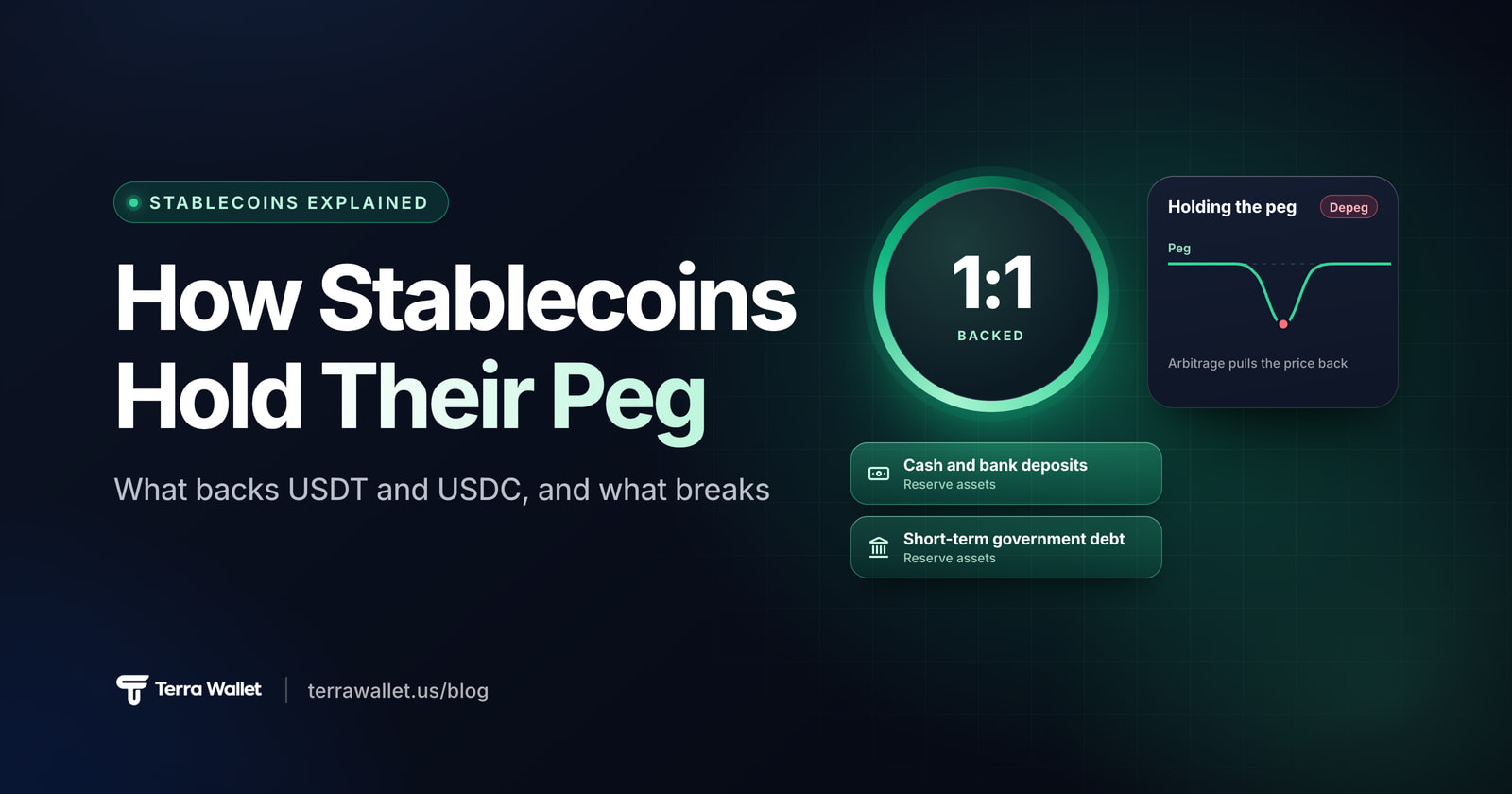
Stablecoins are crypto tokens built to hold a steady price, almost always 1 US dollar, by backing each token with reserves or collateral that can be redeemed. In plain terms, most stablecoins are digital dollar IOUs that live on a blockchain. USDT and USDC are the biggest, and redemption keeps them near $1.
- The biggest stablecoins, USDT and USDC, are backed by reserves held by the companies that issue them. They stay near $1 because approved customers can swap tokens for dollars with the issuer, and traders close any gap.
- Stable is a target, not a guarantee. The algorithmic TerraUSD collapsed in May 2022, and even fully reserved USDC slipped below $1 for a few days in March 2023 when part of its reserves sat in a failed bank.
- The big issuers can freeze tokens at specific addresses, and no wallet can override that.
- The same stablecoin runs on many networks, so always send on the network the receiver expects.
- The rules changed: EU stablecoin rules have applied since June 30, 2024, and the US GENIUS Act takes effect on January 18, 2027.
A stablecoin is a token on a blockchain with one job: stay worth a fixed amount, usually 1 US dollar. Bitcoin and ether move in price every second. Stablecoins exist so you can hold, send and trade dollars on the same rails, at any hour, without going back to a bank each time.
The mechanism that keeps the big ones at $1 is redemption. The issuer sells new tokens for $1 each and buys them back for $1 each, so anyone with an account at the issuer can turn a token back into a dollar. Everyone else trades on exchanges, where the price can drift a little. Arbitrage closes that drift.
Say a wave of selling pushes a dollar stablecoin to $0.99 on exchanges. A trading firm with a redemption account buys 1,000,000 tokens for $990,000, redeems them with the issuer for $1,000,000 and keeps about $10,000 before fees. Its buying lifts the market price back toward $1.
If the token trades at $1.01 instead, the same firm runs the loop in reverse: it pays the issuer $1,000,000 for new tokens and sells them for about $1,010,000. Either way, the gap shrinks. The loop only works while traders trust that redemptions will be paid in full and on time. When that trust cracks, the arbitrageurs step back and the price can fall fast.
Usually not you. Tether's published fee terms set a minimum redemption of 100,000 US dollars, charge the greater of $1,000 or 0.1% per redemption and require a verified account. Circle handles minting and redemption of USDC for business customers. Most people get their dollars back by selling on an exchange, which is why the exchange price is what you feel in a crisis.
Stablecoins differ in what stands behind the $1. The design tells you what can go wrong, so it is the first thing to check. ethereum.org keeps a clear overview of stablecoin designs if you want more detail.
| Type | What backs it | Examples | Main risk |
|---|---|---|---|
| Fiat-backed | Reserves of cash and cash-like assets, such as short-term government debt, held by a company | USDT, USDC | The issuer, its banks and the accuracy of its reserve reports |
| Crypto-backed | More crypto than the stablecoins issued, locked in smart contracts | DAI, USDS | Collateral crashes, forced liquidations and smart contract bugs |
| Commodity-backed | Physical gold held by a custodian | Pax Gold, Tether Gold | The issuer and the vault; the price follows gold, not the dollar |
| Algorithmic | No reserve, only supply rules and often a sister token | TerraUSD (failed in 2022) | A loss of confidence can spiral toward zero |
USDT and USDC, the two largest stablecoins, are both fiat-backed, because one token per dollar in a reserve is the easiest promise to understand and check. Crypto-backed designs avoid a single company holding the cash, but they must lock up more collateral than they issue, and DAI itself holds some centralized stablecoins in its backing. Algorithmic designs deserve the most suspicion, for reasons the history below makes plain.
Both aim for $1, both run on many blockchains and both can be frozen by their issuer. The differences sit in who stands behind them, how they report reserves and where regulators accept them.
| Question | USDT | USDC |
|---|---|---|
| Issuer | Tether | Circle |
| What the issuer says backs it | Tether's reserves; Tether says its assets exceed its liabilities | Mostly the Circle Reserve Fund, an SEC-registered government money market fund, plus cash at large banks |
| Public reporting | Circulation data daily, reserve reports on its transparency page | Reserve holdings weekly, plus monthly assurance from a Big Four accounting firm |
| Direct redemption | Verified customers, 100,000 US dollar minimum | Business customers |
| Status under the EU's MiCA rules | Not issued by an authorized e-money token issuer | Issued in the EU by Circle's French entity, an e-money institution whose MiCA authorization Circle announced on July 1, 2024 |
| Can the issuer freeze it | Yes, under Tether's terms | Yes, under Circle's blocklisting policy |
For a holder, the practical gaps are disclosure, redemption access and regulation. In the EU, platforms have been told to stop offering services in stablecoins whose issuers lack authorization, which leaves USDC with far wider access there. On freezes, the two are closer than people think: Tether's terms let it freeze tokens and blacklist addresses, and Circle's let it block addresses linked to illegal activity or named in a valid legal order. Neither coin is a bank deposit.
Two episodes explain most of what can go wrong with a dollar token.
TerraUSD (UST) was an algorithmic stablecoin on the Terra blockchain, a project unrelated to Terra Wallet (our FAQ covers the name). It held no cash reserve. It was supposed to keep its peg by being exchangeable for its sister token, LUNA. In May 2022 it broke from the dollar and both tokens fell to almost nothing, as the SEC later set out in its case against Terraform Labs.
The lesson: a peg defended only by a token the same project can print is only as strong as confidence in that project. When confidence went, the mechanism made the fall worse, not better.
USDC is fully reserved, yet it slipped below $1 on March 11, 2023. Circle had disclosed that about $3.3 billion, roughly 8% of its reserves, sat at Silicon Valley Bank, which had just failed. On March 12, the Treasury, the Federal Reserve and the FDIC issued a joint statement that all of the bank's depositors would have access to their money from Monday, March 13, and USDC was back at its peg within days.
The lesson: even good reserves carry bank risk and timing risk, and markets price that risk within hours. In both cases the price fell before anyone knew the outcome, which is the risk that matters if you might need your dollars quickly.
Save this list. It takes five minutes and covers what most guides skip.
- Who issues it, and who regulates that issuer where you live? In the EU, check whether the issuer is authorized under MiCA. In the US, payment stablecoins must come from permitted issuers once the GENIUS Act takes effect.
- What backs it, and how often is that reported? Look for regular, independent reserve reports with a breakdown, not just a reassuring sentence on a homepage.
- Who can redeem, at what minimum and fee? If you cannot redeem, your exit is an exchange, at whatever price it offers that day.
- Can it be frozen? Fiat-backed coins usually can. That helps theft victims, but it also means the token is not censorship-resistant.
- Which network and which contract? USDT on Tron and USDT on Ethereum are separate tokens. Anyone can launch a fake token named USDT, so the contract address is what identifies the real one. Stablecoin senders are also a favorite target of address poisoning, so check the whole recipient address too.
- Do you hold the network's coin for fees? Sending USDT on Tron needs TRX (or energy from staked TRX), on Ethereum it needs ETH to pay gas fees, and on BNB Smart Chain it needs BNB.
Terra Wallet lists each stablecoin version as its own asset labeled with its network, so USDT on Tron and USDT on Ethereum never blur together. To receive, tap Receive, pick the network the sender will use and share that address; the supported networks page shows what works where. Well-known tokens carry a blue verified badge tied to the contract address, and in the Android app, look-alike spam tokens on EVM networks move to a hidden section.
Your keys stay on your device, but issuer freezes still apply, because they live in the token contract, not in any wallet. You can get the Android app or the browser extension from the download page.
- July 18, 2025: the US GENIUS Act became law. It requires reserves of at least 1:1 in cash, deposits and short-term Treasuries, monthly public reserve reports and no interest paid by issuers. Our GENIUS Act guide walks through it.
- October 8, 2026: ESMA, the EU securities regulator, told national supervisors that MiCA-authorized platforms should stop providing services in non-compliant stablecoins, apart from wind-down functions such as withdrawals.
- October 21, 2026: the OCC issued its final rule under the GENIUS Act. Issuers it supervises must redeem within two business days and cannot set a minimum above one token once a customer is onboarded.
- January 18, 2027: the GENIUS Act and the OCC rule take effect.
In the EU, MiCA's e-money token rules have applied since June 30, 2024. Holders of a compliant euro or dollar token can redeem at par, at any time, with no fee, and neither the issuer nor platforms may pay interest on it.
They are steadier than volatile coins for holding value, but not risk-free. You depend on the issuer's reserves, its banks, its willingness to redeem and its freeze policy. They are not bank deposits: the GENIUS Act states that payment stablecoins are not covered by FDIC deposit insurance.
Yes. In stress, exchange prices can drop below $1, as USDC did for a few days in March 2023, and a poorly designed coin can fail outright, as TerraUSD did in May 2022. A peg holds only while redemption is trusted.
Not from the issuer under the main rulebooks. The GENIUS Act bans permitted issuers from paying interest or yield to holders, and MiCA bans interest on e-money tokens. Yield advertised on a stablecoin comes from lending or a platform program, with its own risks.
Both are meant to be worth $1, but they are separate tokens on separate blockchains, and you cannot send one to an address on the other. Use the network the receiver supports. Our comparison of USDT TRC20 vs ERC20 vs BEP20 covers fees and common mistakes.
This article is for education only and is not financial, investment, tax or legal advice.
Sources
- ethereum.org: Stablecoins (opens in a new tab)
- circle.com: Transparency (opens in a new tab)
- circle.com: USDC terms (opens in a new tab)
- circle.com: Circle is first global stablecoin issuer to comply… (opens in a new tab)
- tether.to: Transparency (opens in a new tab)
- tether.to: Fees (opens in a new tab)
- tether.to: Legal (opens in a new tab)
- sec.gov: Press release 2023-32 (opens in a new tab)
- home.treasury.gov: Press releases jy1337 (opens in a new tab)
- en.wikipedia.org: USD Coin (opens in a new tab)
- congress.gov: PLAW 119publ27 (opens in a new tab)
- occ.gov: NR OCC 2026-92 (opens in a new tab)
- occ.gov: NR OCC 2026 92a PDF (opens in a new tab)
- esma.europa.eu: Article 49 issuance and redeemability (opens in a new tab)
- esma.europa.eu: Article 50 prohibition granting interest (opens in a new tab)
- esma.europa.eu: Opinion on the provision of crypto asset services… PDF (opens in a new tab)
- esma.europa.eu: EMTWP CSV (opens in a new tab)