
What Is Blockchain? Explained Step by Step, Without Jargon
A blockchain is a shared record that thousands of computers keep in sync and nobody can quietly edit. Here is how it works, step by step, in plain English.

Written by Kevin Zhang
7 min read
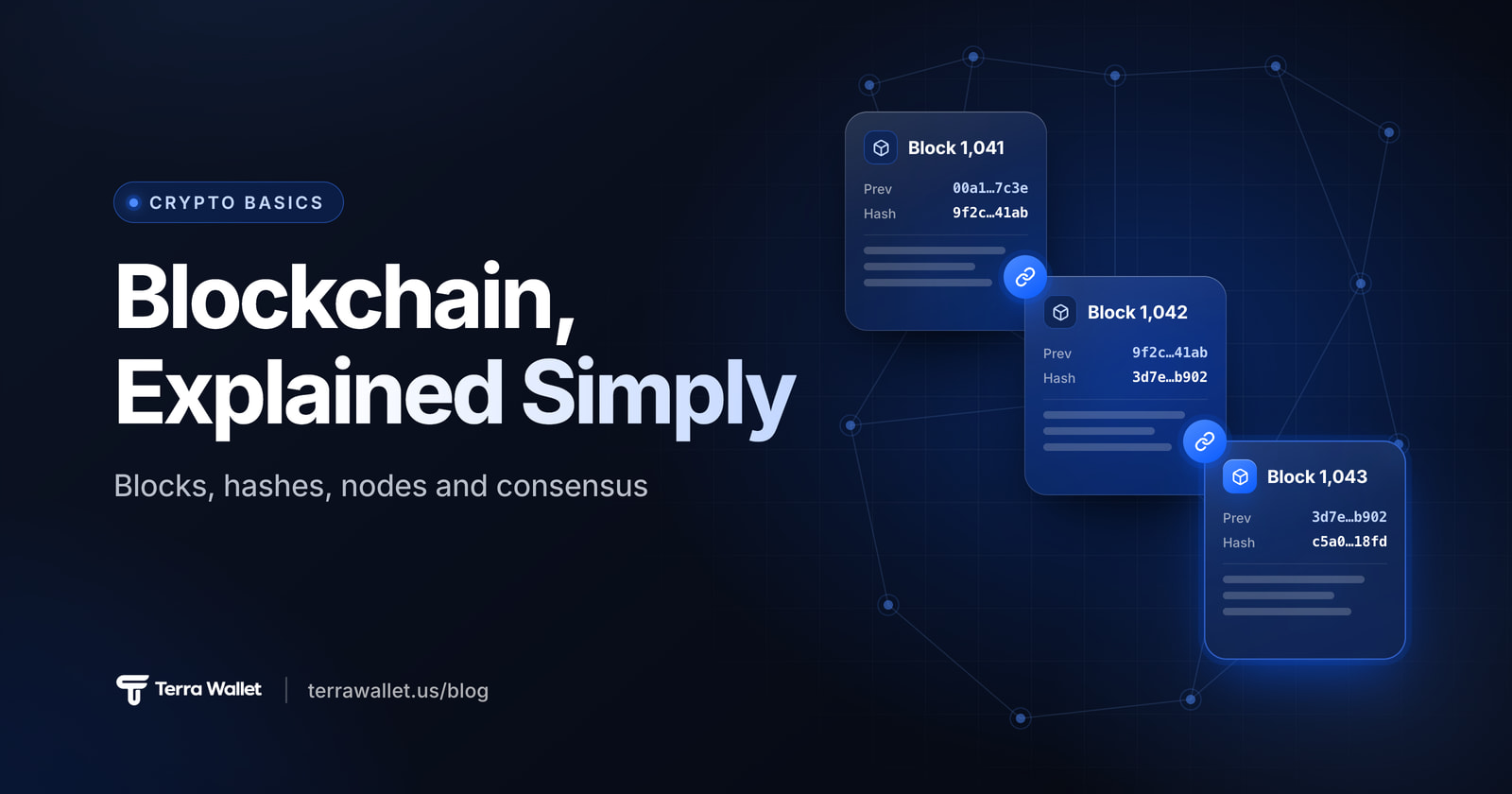
A blockchain is a shared digital record that thousands of independent computers keep identical copies of. New entries are added in batches called blocks, each block is linked to the one before it by a cryptographic fingerprint, and the network agrees on new blocks by fixed rules, so nobody can quietly rewrite the past.
This guide takes it one step at a time: a simple analogy, what happens when you send a transaction, the parts that make it work, and what the technology is and is not good for.
- What is blockchain, in one line: a record many computers keep in sync, chained together so the past cannot be quietly edited.
- Bitcoin, launched in January 2009, was the first blockchain; many networks have followed, such as Ethereum and Solana, each with its own rules.
- Proof of work and proof of stake are the two main ways strangers agree on the next block.
- Blockchains are good at moving value and keeping public records without a middleman, and poor at privacy, undo buttons and facts about the outside world.
- A wallet does not hold coins; it holds the keys that move them.
Picture five friends who share expenses and keep a notebook of who paid what. Instead of trusting one person with it, each keeps an identical copy. Every evening the day's entries go on a new page, and the top of each page carries a short code calculated from everything on the page before.
If someone secretly edits an old page, its code stops matching, every later page breaks, and the other four copies disagree. Swap the friends for computers, the pages for blocks and the codes for cryptographic hashes, and you have a blockchain. Nobody owns the notebook, everyone can read it, and every copy enforces the same rules for adding a page.
Here is what happens when you send bitcoin from a wallet, in order:
- You sign. Your wallet creates a transaction, a message that moves an amount from your address to another, and signs it with your private key.
- It spreads. The transaction goes out to the network, and each node checks the signature and that the coins have not already been spent.
- It waits. Valid transactions sit in a waiting area called the mempool until a miner or validator picks them up, usually highest fee first.
- A block is built. The miner or validator bundles transactions into a block that includes the fingerprint of the previous block.
- The network agrees. Nodes check the new block against the rules and add it to their copy if it passes.
- It settles. Every block added on top is another confirmation, and changing your transaction gets harder with each one.
A transaction is signed with a private key, a secret number only the owner holds. Anyone can check the signature with the matching public key without learning the secret, which is how the network knows a payment is genuine. Your wallet does the signing for you.
A block is a batch of transactions plus a small header. Each network has its own rhythm: Bitcoin adds a block about every 10 minutes on average, while Ethereum's proof-of-stake chain runs in 12-second slots. The first Bitcoin block was mined on January 3, 2009.
A hash function turns any data into a fixed-length fingerprint, and changing one character changes the whole result. Run through SHA-256, the function Bitcoin uses, the text "Alice pays Bob 5" gives a fingerprint starting 66ed59eb, while "Alice pays Bob 6" gives one starting 08155743. There is no practical way to work backward from a fingerprint to the input.
Each block carries the hash of the block before it, which is what makes it a chain. The Bitcoin white paper put it this way:
Each timestamp includes the previous timestamp in its hash, forming a chain, with each additional timestamp reinforcing the ones before it.
A node is a computer running the network's software. A full node keeps its own copy of the chain and checks every block against the rules, rejecting anything invalid, such as a coin spent twice. Bitcoin has thousands of reachable nodes run by individuals, companies and hobbyists, and anyone can start one.
The hard part is deciding who adds the next block when nobody is in charge. Miners or validators are paid in the network's own coin, through new coins and fees, and the fees also stop people from flooding the network with junk. The two main ways to choose who adds a block compare like this:
| Feature | Proof of work | Proof of stake |
|---|---|---|
| Who adds blocks | Miners racing to find a valid hash | Validators chosen from those who locked up coins |
| Cost of taking part | Hardware and electricity | Coins put up as collateral |
| Penalty for cheating | Electricity wasted on blocks the network rejects | Part or all of the stake can be destroyed |
| Best-known example | Bitcoin | Ethereum, since September 2022 |
| Energy use | High by design | Low: Ethereum's switch cut its electricity use by more than 99.988 percent, by one estimate |
In proof of work, the chain with the most accumulated work wins, so rewriting history means redoing the work for a block and everything after it, faster than the rest of the network combined. In proof of stake, reverting a finalized block on Ethereum would cost an attacker at least a third of all staked ETH. Our guide to crypto staking rewards and risks covers what that design means for people who stake.
To alter last month's payment, an attacker would have to rewrite that block, recompute every block since and get the network to accept the new version over the honest one. On a large network that costs more than it could earn, which is why the white paper argues that playing by the rules is the profitable choice.
It is also why exchanges wait for several confirmations, extra blocks on top of yours, before they accept a deposit. The guarantee has limits: a small network with little mining power or stake is far easier to attack than Bitcoin or Ethereum.
Blockchains get oversold as a fix for everything. They are genuinely useful for a narrower set of jobs:
- Moving value without a middleman, at any hour, to anyone with an address.
- Public records anyone can check. Anyone running a node can audit Bitcoin's supply, which is how the 20 millionth bitcoin could be confirmed in March 2026, as our bitcoin halving guide explains.
- Rules nobody can change quietly. Changes need broad agreement from the people running the software.
- Ownership without permission. If you hold the keys, no company can freeze native coins at your address.
They are a poor fit for other jobs:
- Facts about the outside world. A blockchain can prove a payment happened, not that the package arrived.
- Privacy. On public chains, anyone can look up an address's balance and history.
- Undo buttons. A confirmed transaction cannot be reversed, even if it went to the wrong address.
- Jobs a normal database does fine. If one trusted organization already keeps the record, a blockchain usually adds cost without adding trust.
NIST's Blockchain Technology Overview sorts networks into two kinds. Permissionless blockchains, like Bitcoin and Ethereum, let anyone read and write to them, while permissioned ones only let authorized participants publish blocks, which suits organizations that want tighter control over who takes part.
A crypto wallet does not store coins. The coins are entries on the blockchain; the wallet stores the keys that sign transactions moving them, and reads the chain to show your balance. That is why you can lose your phone and still recover everything with your recovery phrase.
Terra Wallet works with 14 blockchains, including Bitcoin, Ethereum and Solana, from one recovery phrase that covers many chains. Each network keeps its own record, so a balance on one network is separate from a balance on another. In the Android app, transactions in the Activity tab link to a block explorer, so you can check them on the public record yourself.
You can download Terra Wallet for Android or as a browser extension, and the wallet FAQ covers the basics. For a next step on Bitcoin, our guide to bitcoin address types explains what those bc1 and 1 addresses mean.
No. Bitcoin was the first blockchain, launched in January 2009. The technology has since been reused by many other networks, such as Ethereum and Solana, each with its own rules and coin.
The design was introduced in Satoshi Nakamoto's Bitcoin white paper, published on October 31, 2008. The paper built on earlier research into time-stamping digital documents, including a 1991 paper by Haber and Stornetta that it cites.
Rewriting the record of a large blockchain is extremely expensive. Most crypto losses come from elsewhere: stolen recovery phrases, scams, buggy smart contracts and hacked bridges. Storing your recovery phrase safely matters far more than worrying about the chain itself.
Sources
- bitcoin.org: Bitcoin PDF (opens in a new tab)
- csrc.nist.gov: IR 8202 (opens in a new tab)
- ethereum.org: Energy consumption (opens in a new tab)
- ethereum.org: PoS (opens in a new tab)
- bitcoin.org: FAQ (opens in a new tab)
- blockworks.co: Bitcoin genesis block fifteeth birthday (opens in a new tab)
- bitnodes.io: Nodes 1776536291 (opens in a new tab)
- theblock.co: Bitcoin mined supply hits 20 million BTC (opens in a new tab)