
Address Poisoning: How the Scam Works and 7 Ways to Stop It
Scammers plant look-alike addresses in your history and wait for you to copy one. See how address poisoning works, what it has cost victims and seven habits that stop it.

Written by Hannah Lee
7 min read
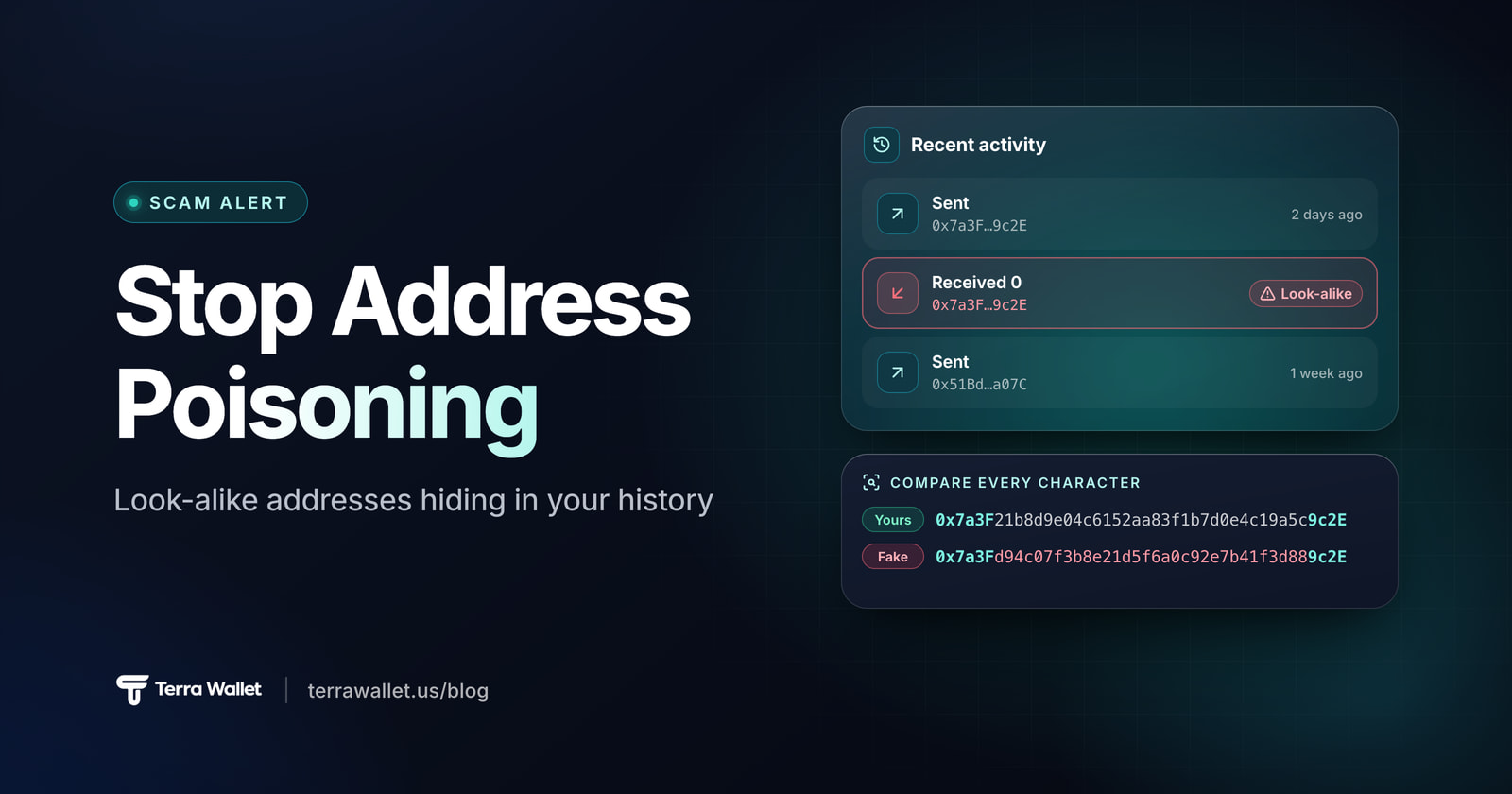
Address poisoning is a crypto scam in which an attacker plants a look-alike address in your transaction history, one that shares the first and last characters of an address you really use, then waits for you to copy it by mistake. It never touches your keys, but a payment sent to the fake is final.
This guide explains how the trick works, why it catches careful people, what two real cases cost and seven habits that make it fail. It also covers what to do if you have already sent funds to a poisoned address.
- The scam only works if you copy a recipient from your history, so never do that. Use the original source or a saved contact.
- Check the whole address in chunks, especially the middle, which is where a look-alike differs.
- A test transfer does not protect you. Bots can plant a look-alike within minutes of it, so copy the address again from the source for the main payment.
- Zero-value and tiny transfers from strangers are bait. They cannot move your funds, so ignore them.
- The losses are real: at least $83.8 million across two networks in two years, and a single loss of about $50 million in December 2025.
Crypto addresses are long, so wallets and block explorers shorten them to something like 0x7a3F...91c2. Over time, most people check those few visible characters and nothing else. Address poisoning is built on exactly that habit.
- The attacker watches the chain. Bots scan public blockchains for wallets that move meaningful amounts, stablecoins in particular.
- They generate a look-alike. Vanity address software churns out addresses until one matches the start and end of an address you send to or receive from.
- They poison your history. The attacker creates a transaction between your wallet and the look-alike, so the fake appears in your activity list next to the real one.
- They wait. The next time you need that address, you open your history, copy the entry that looks right and paste it. The funds go to the attacker.
Speed is part of the plan. In a Tron case documented by blockchain analytics firm TRM Labs, a look-alike address sent dust to a wallet about 18 seconds after that wallet made a USDT transfer.
Each character of an Ethereum-style address is one of 16 hexadecimal values. A fake that matches the first five and last four characters has to beat odds of 16 to the power of 9, roughly 1 in 69 billion.
That sounds safe until you see the hardware. Carnegie Mellon researchers measured a GPU-based vanity generator at about 516 million addresses per second on a workstation graphics card, so a nine-character match takes around two minutes on average. Every extra matching character multiplies the work by 16, which is why the middle of the address is where a fake gives itself away.
| Variant | What shows up in your history | How to spot it |
|---|---|---|
| Zero-value transfer | A transfer of 0 tokens that appears to go from you to the look-alike, as if you had paid it before. Because of how many token contracts handle zero-amount transfers, the attacker can create it without your keys. | You never sent it, and the amount is 0. |
| Tiny transfer (dust) | A small real amount of a coin or token arriving from the look-alike. | An unknown sender and a tiny amount, often minutes after one of your real transfers. |
| Counterfeit token | A transfer of a fake token with a familiar name, such as a fake USDT, often for the same amount you just sent. | The token contract is not the official one, and the token usually has no market price. |
The scale surprises most people. A peer-reviewed study presented at USENIX Security 2025 measured address poisoning on Ethereum and BNB Smart Chain from July 2022 to June 2024. It found about 270 million attack attempts aimed at about 17 million victims, and 6,633 successful attacks that cost victims at least $83.8 million.
So only a tiny share of attempts works, yet the researchers found that some organized groups still earn 10 to 20 times what they spend. Two cases show how a success plays out:
- May 3, 2024. A victim sent 1,155 wrapped bitcoin (WBTC), worth about $68 million at the time, to a look-alike of an address they had used before. In a very rare ending, the attacker returned all of it, as about 22,960 ETH, after a week of on-chain negotiation.
- December 2025. A trader moving about $50 million in USDT on Ethereum first sent a 50 USDT test to the correct address. An attacker then seeded the history with a look-alike matching the first five and last four characters, and 26 minutes after the test the full 49,999,950 USDT went to the fake. The attacker swapped it within 30 minutes and pushed most of it through a mixer, and no recovery was reported.
The second case is the one to remember. A test transfer proves an address works, but it does nothing to protect the next copy and paste. On a public chain, the test also tells the bots exactly which address to imitate.
None of these habits needs special tools. Together they make the scam close to impossible.
- Never copy an address from your transaction history. That includes your wallet's activity list and block explorers. Get it from the source every time: the person you are paying, the exchange's deposit page or your address book.
- Save regular recipients once. Add addresses you pay more than once to your wallet's address book, copied from a trusted source, and pick them by name afterward.
- Check the whole address, in chunks. Compare it four characters at a time from start to finish, giving the middle the most attention. For a large payment, ask the recipient to read back a few characters from the middle.
- Copy again after a test transfer. Keep sending test amounts, but take the address for the main transfer from the original source, never from history.
- Treat zero-value and tiny transfers from strangers as hostile. Do not send anything back, do not open links in token names or memos, and do not try to sell an unknown token on an unfamiliar site.
- Use names where you can. ENS names ending in .eth and Solana names ending in .sol resolve to an address. Confirm the resolved address the first time you use a name.
- Slow down on big amounts. The attack depends on hurry. If anything feels off, stop and start again from the original address.
Ethereum's mixed-case checksum, defined in EIP-55, gives a mistyped address only about a 0.0247 percent chance of passing as valid, so it is excellent against typos. A look-alike, though, is a real address with its own correct checksum, so every wallet accepts it. Tron addresses and Bitcoin address types have checksums with the same limit.
Usually not. Open the transaction on a block explorer and compare the recipient with the address you meant to use, character by character. If they differ, the transfer is final, and no wallet or blockchain can undo it. A few steps still matter:
- Report it quickly. File a report with the police or, in the US, with the FBI's Internet Crime Complaint Center, and include the transaction hash. Some stablecoin issuers, such as Tether for USDT and Circle for USDC, can freeze their tokens at an address, so speed matters most with stablecoins.
- Keep your wallet. Poisoning never touches your keys, so the rest of your funds are not at risk because of it, and you do not need a new recovery phrase.
- Ignore recovery offers. Scam victims are often targeted a second time by fake recovery services. Anyone who wants an upfront fee to get crypto back is running another scam, as our guide to fake support, fake apps and fake airdrops explains.
Good habits come first, but a wallet can catch what tired eyes miss. In Terra Wallet, both the Android app and the browser extension warn you on the send screen when a recipient looks like an address you have used before but is different. Suspicious tiny transfers are hidden from your activity, and opening one shows a warning such as "Tiny transfer from an unknown sender".
The Android app also skips push alerts for very small amounts of a network's coin, so dust does not prompt you to open your history. For saved recipients, use the address book in Settings, which stores contacts for EVM networks, Solana, Bitcoin and Tron on your device. The wallet security page and the answers on address poisoning and dust transfers go into more detail, and our crypto phishing checklist handles the tricks that arrive through links and messages.
No. The attacker never gets your keys or any permission over your funds. The scam only works if you send a transaction to the look-alike yourself, which is why checking the recipient defeats it.
It is a token transfer for an amount of 0, and one you did not make is almost always an address poisoning attempt. It cannot move your funds, so ignore it and never copy the address it shows.
Do not interact with it at all. Sending it back costs fees and achieves nothing, and links in token names or memos usually lead to phishing sites that ask for a signature or your recovery phrase.
Sources
- usenix.org: Tsuchiya (opens in a new tab)
- arxiv.org: 2501.16681v3 (opens in a new tab)
- cylab.cmu.edu: 07 blockchain address poisoning (opens in a new tab)
- coindesk.com: Exploiter steals 68m worth of crypto through address… (opens in a new tab)
- cointelegraph.com: WBTC address poisoner all funds negotiations (opens in a new tab)
- theblock.co: Crypto trader loses 50 million in address poisoning… (opens in a new tab)
- trmlabs.com: Understanding address poisoning on the TRON blockchain (opens in a new tab)
- eips.ethereum.org: EIP-55 (opens in a new tab)